

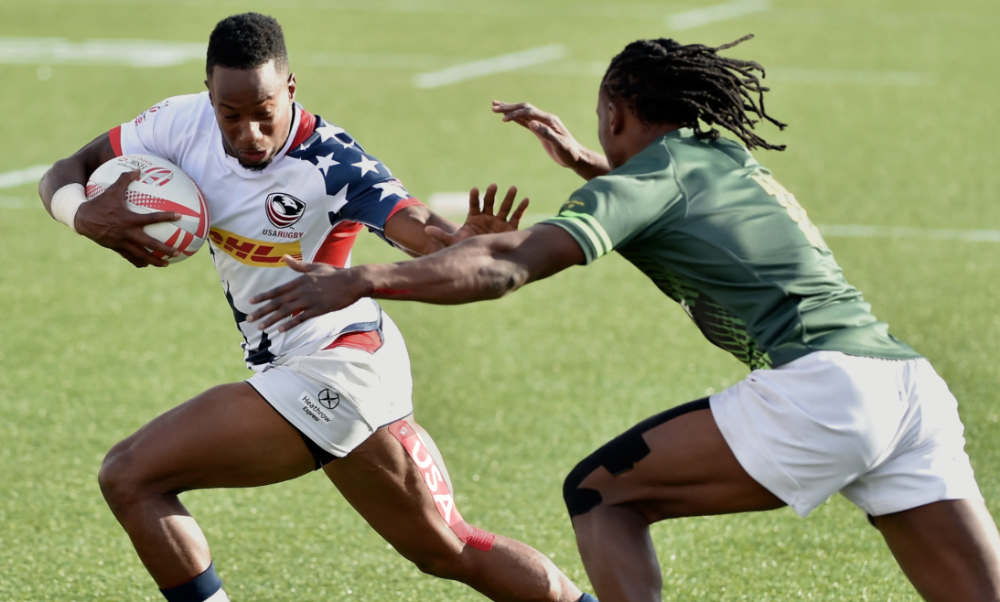
Rugby sevens will arrive at the Los Angeles Olympics in 2028 with a paradoxical status: established enough to be a proven Olympic success, yet suddenly under more competitive pressure than at any point since its inclusion in 2016.
The pressure is not abstract. It is structural, commercial, and immediate.
Los Angeles 2028 will introduce flag football, lacrosse (sixes), and cricket (T20) as additional Olympic sports—each chosen deliberately to reflect American sports culture while unlocking new global audiences. These sports are not treating the Olympics as a novelty. They are mobilizing their best athletes, their most recognizable brands, and their most powerful domestic partners.
Rugby sevens finds itself competing in the same city, the same broadcast windows, and the same attention economy.
That should focus minds.
Flag football’s Olympic debut has been matched by unprecedented institutional backing. In March, the NFL confirmed plans to launch a professional men’s and women’s flag football league ahead of LA28, backed by all 32 franchises and a roster of star investors, including current and former NFL players and major figures from U.S. sport. NFL owners have also voted to permit active players to compete at the Games.
Cricket’s return to the Olympics—its first since 1900—comes with defined venues, a six‑team men’s and women’s T20 format, and explicit ambitions to leverage American exposure alongside massive over 1bn person South Asian broadcast markets. Lacrosse will re‑enter the Games for the first time in over a century with a streamlined, television‑friendly six‑a‑side model designed for speed and accessibility, that is already a known commodity if youth, high school and collegiate sports.
These sports share a common approach: simplify the product, showcase stars, and treat the Olympics as a launchpad rather than a reward.
Rugby sevens already knows what success looks like in this environment. Paris 2024 shattered long‑held assumptions about rugby’s Olympic ceiling. The tournament sold more than 500,000 tickets, with nearly 70,000 fans packing Stade de France on a single day, making sevens one of the most attended events of the Games. Athletes like Antoine Dupont and Ilona Maher transcended the format, turning short matches into global moments that reached well beyond traditional rugby audiences.
Paris proved that when rugby presents a clear, elite product, fans follow.
Los Angeles, however, will raise the stakes. Sevens will be played at the AEG owned Dignity Health Sports Park in Carson, a 27,000‑seat venue already confirmed as an Olympic site, with dates locked and ticketing underway. This will not be an experimental setting. It will be one of the most commercially intense Olympic environments ever assembled.
Which raises the central question for World Rugby and its member unions:
Is rugby prepared to treat the Olympics as a best‑on‑best showcase—or will sevens continue to straddle the line between development pathway and elite competition?
Other sports have made their choice. The NFL, ICC, and World Lacrosse are not debating whether their leading athletes belong on the Olympic stage. They are designing systems to ensure they arrive there.
Rugby does not lack the raw material. Sevens is fast, diverse, gender‑balanced, and built for modern broadcast. What it lacks—at least today—is alignment. Alignment between formats. Alignment between calendars. Alignment between ambition and execution.
For decades, global rugby has viewed the United States with a mix of envy, disdain, and hopefulness: envy of its scale, disdain for its fragmentation, hope that it could finally deliver permanence. LA28 removes the option of waiting.
The Olympics reward sports that arrive prepared, recognisable, and confident in what they are offering. Paris showed what rugby can be. Los Angeles will decide what it becomes.
The moment is here. Waiting is no longer neutral.
By Dan Lyle for RugbySeason.com